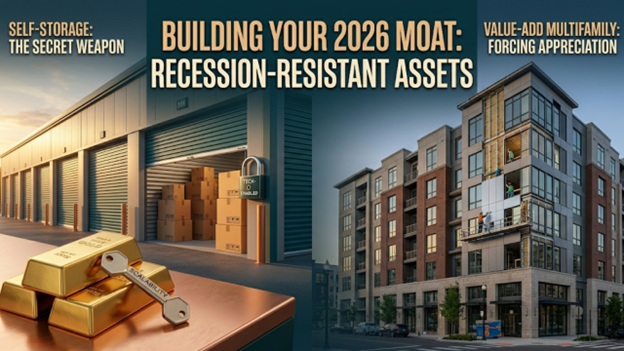
In the current economic climate of 2026, the pursuit of yield has been replaced by the pursuit of resilience. For the sophisticated investor, the goal is no longer just about catching the next wave of growth; it is about building a “moat” around their capital. While retail and office sectors face structural transformations, two asset classes have emerged as the “anti-cycle” stalwarts of the modern era: Multifamily and Self-Storage.
This pillar focuses on why these niche commercial sectors are considered “secret weapons” for high-interest-rate environments and how they provide protection during periods of volatility.
Self-Storage: The “Secret Weapon” of 2026
While often overlooked in favor of more “glamorous” high-rises, self-storage has quietly become one of the most efficient wealth-building engines in real estate. Its strength lies in its fundamental simplicity and its unique behavior during economic shifts.
Low Overhead, High Retention
The beauty of self-storage is the operational efficiency. Unlike multifamily, there are no “tenants, toilets, or trash.” A typical self-storage facility requires minimal staffing and low capital expenditure for maintenance. In 2026, as labor and material costs remain elevated, the low-overhead model of storage provides a significant buffer for profit margins.
Furthermore, self-storage benefits from “sticky” demand. During economic booms, people buy more “stuff” and need a place to put it. During downturns, people downsize their living situations and need a place to keep their belongings. This dual-sided demand creates a high retention rate that is rarely seen in other asset classes.
The Tech-Driven Edge
Modern self-storage isn’t just a row of metal sheds. The 2026 model utilizes contactless entry, AI-driven dynamic pricing, and automated security. These technological integrations allow owners to adjust rents in real-time based on local supply and demand, much like a hotel or airline, ensuring the asset is always operating at peak revenue potential.
Value-Add Multifamily: Forcing Appreciation in High-Rate Environments
With interest rates stabilized at a “higher-for-longer” baseline in 2026, the days of relying on market compression (cap rate compression) for returns are over. To succeed today, investors must master the art of Forced Appreciation.
Strategies for 2026
- Operational Alpha: Efficiency is the new growth. Investors are looking beyond cosmetic renovations to “operational value-add” implementing RUBS (Ratio Utility Billing Systems), optimizing trash valet services, and reducing turnover through community-building initiatives.
- Targeted Interior Upgrades: Rather than gutting every unit, smart operators are focusing on high-impact upgrades that justify rent premiums, smart thermostats, modern lighting, and dedicated home-office nooks that cater to the permanent remote-work force.
- Expense Mitigation: In an inflationary environment, controlling the “bottom line” is as important as growing the “top line.” This includes solar installations to offset common area power or water-saving fixtures that significantly reduce municipal utility bills.
By increasing the Net Operating Income (NOI) through these active management strategies, investors can increase the property’s value regardless of what is happening in the broader macro-economic environment.
The “Anti-Cycle” Play: Lessons from 2008 and 2023
To understand why self-storage and multifamily are recession-resistant, we must look at the historical data. The resilience of these assets during the Great Financial Crisis (2008) and the banking volatility of 2023 provides a roadmap for 2026.
Historical Resilience
- The 2008 Lesson: While homeownership rates plummeted, multifamily occupancy surged. People always need a roof over their heads. Similarly, self-storage was the only REIT sector to post positive returns in 2008. As families lost homes, they moved their lives into 10×20 units.
- The 2023 Shift: When regional banking failures caused a credit crunch, institutional capital fled speculative developments. However, capital remained “warm” toward self-storage and multifamily because their cash flows remained predictable. They are considered “defensive” assets because they provide essential services.
Economic Volatility as a Catalyst
Economic volatility often acts as a catalyst for these sectors. Inflation, for example, is a friend to the short-term lease. Unlike an office building with 10-year leases that get “eaten” by inflation, multifamily (12-month leases) and self-storage (month-to-month leases) can reset prices almost instantly to keep pace with rising costs.
Strategic Synthesis: Building Your 2026 Moat
The “Recession-Resistant” pillar isn’t about avoiding risk; it’s about choosing the right kind of risk. By focusing on asset classes with low overhead, essential demand, and the ability to force appreciation, you move from being a spectator of the economy to a beneficiary of its cycles.
Whether it’s the scalability of a 500-unit storage facility or the stable cash flow of a value-add apartment complex, these assets provide the foundation for a portfolio that doesn’t just survive volatility it thrives because of it.
Key Takeaway: In 2026, the most sophisticated guidance centers on durability. Assets that solve the basic human needs of shelter and storage are the ultimate hedges against an unpredictable world.
Why Niche Matters
Focusing on these “niche” commercial sectors allows your brand to build Topical Authority. While generalists talk about “Real Estate,” specialists talk about “Multi-Tenant Self-Storage Cap Rate Spreads.” This level of sophistication is exactly what high-net-worth individuals and accredited investors are looking for as they navigate the complexities of 2026.