
For high-net-worth individuals, the transition from active landlord to passive investor is rarely about a lack of capital; it is about the scarcity of time. While direct ownership offers total control, it often becomes a “glorified second job” that restricts a portfolio’s growth. In 2026, as the U.S. real estate market adapts to shifting interest rate environments and the rise of institutional-grade multifamily and self-storage assets, sophisticated investors are increasingly turning to Real Estate Syndication.
This guide explores how to evaluate these private placements, decode profit structures, and determine which path direct or syndicated truly leads to scalable wealth.
The Accredited Investor’s Guide to Due Diligence
In a private placement memorandum (PPM), the “projections” are the hook, but the “disclosures” are the reality. For the accredited investor, due diligence must move beyond simple yield chasing.
5 Red Flags in Real Estate PPMs
- Aggressive Exit Cap Rates: If a sponsor projects a lower exit cap rate than the current market entry rate, they are betting on market appreciation rather than operational improvement. In 2026’s “higher-for-longer” rate environment, this is a major risk.
- The “Opaque” Fee Structure: While acquisition and asset management fees are standard, look for “hidden” markups on construction management or excessive refinance fees that dilute investor equity before the first distribution.
- Inexperienced Sponsorship Teams: A track record in single-family rentals does not translate to managing a 300-unit multifamily complex. Ensure the GP (General Partner) has “lived through a cycle.”
- Insufficient Capital Reserves: Red-line any deal that doesn’t detail a robust rainy-day fund for unexpected repairs or high vacancy periods.
- Unrealistic Rent Growth: Projecting 5–7% annual rent growth in a market where historical averages are 2–3% is a red flag indicating “pro-forma fluff.”
Preferred Return vs. Waterfall Structures: How You Get Paid
Understanding how profits flow from the asset to your bank account is critical. In 2026, syndication structures have become more nuanced to align sponsor incentives with investor protection.
The Preferred Return (The “Safety Net”)
Most syndications offer a Preferred Return (Pref), typically between 6% and 8%. This means investors receive 100% of the distributed cash flow until they hit this percentage of their initial investment. Only after this hurdle is met does the sponsor begin to participate in the profits.
The Waterfall (The “Scalability Engine”)
The “Waterfall” defines how remaining profits are split once the Pref is met. A common 2026 structure might look like this:
- Tier 1: 100% to Investors until 8% Pref is met.
- Tier 2: 70/30 Split (Investors/Sponsor) until a 15% Internal Rate of Return (IRR) is achieved.
- Tier 3: 50/50 Split thereafter.
This structure ensures the sponsor is highly motivated to exceed expectations, as their largest payday only occurs after the investors have been handsomely rewarded.
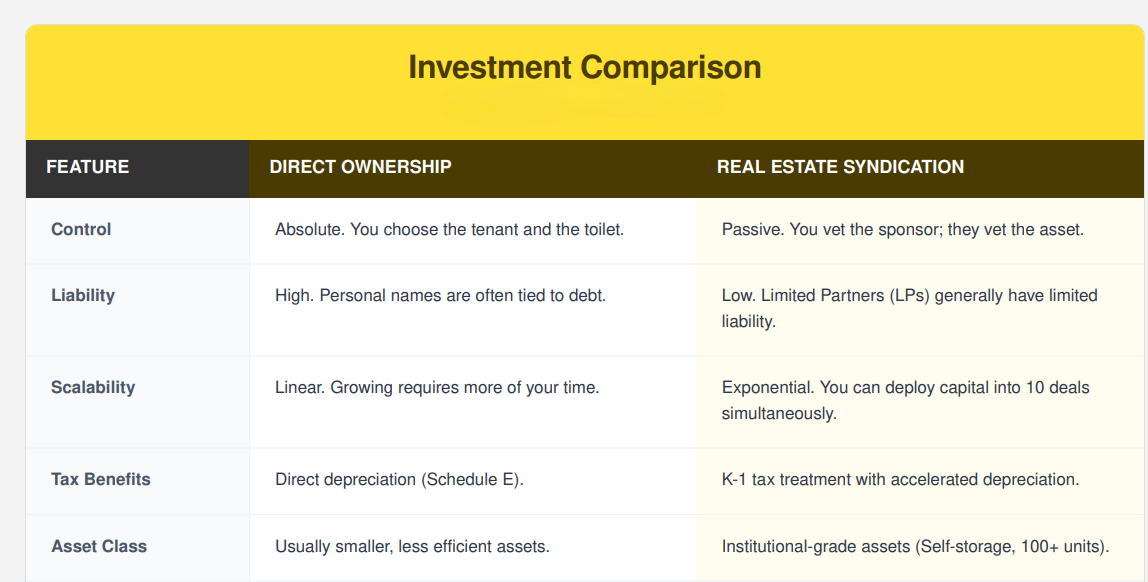
Direct Ownership vs. Real Estate Syndication: The Scalability Audit
Choosing between direct ownership and syndication is a choice between control and leverage.
Which Path is Right for You?
Direct Ownership is ideal for the “builder” phase of wealth—those with more time than capital who want to learn the industry from the ground up. However, it hits a ceiling when the management of 10–20 units begins to erode your professional performance or personal life.
Syndication is the “multiplier” phase. It allows you to leverage the expertise of full-time operators and the economies of scale found in 200-unit apartment buildings or massive self-storage facilities. For the individual looking to build a $10M+ portfolio without hiring a full-time staff, syndication is the only logical path to scalability.
As we navigate the current economic landscape, the “silent weapon” of the sophisticated portfolio isn’t just the asset itself, it’s the structure of the investment. By mastering PPM due diligence and understanding the mechanics of the waterfall, accredited investors can stop trading time for rent checks and start building a truly passive, institutional-grade legacy.
Pro Tip: When evaluating a 2026 syndication, ask the sponsor for their “Sensitivity Analysis.” This shows how the deal performs if interest rates rise or occupancy drops, giving you a clear view of the floor not just the ceiling.