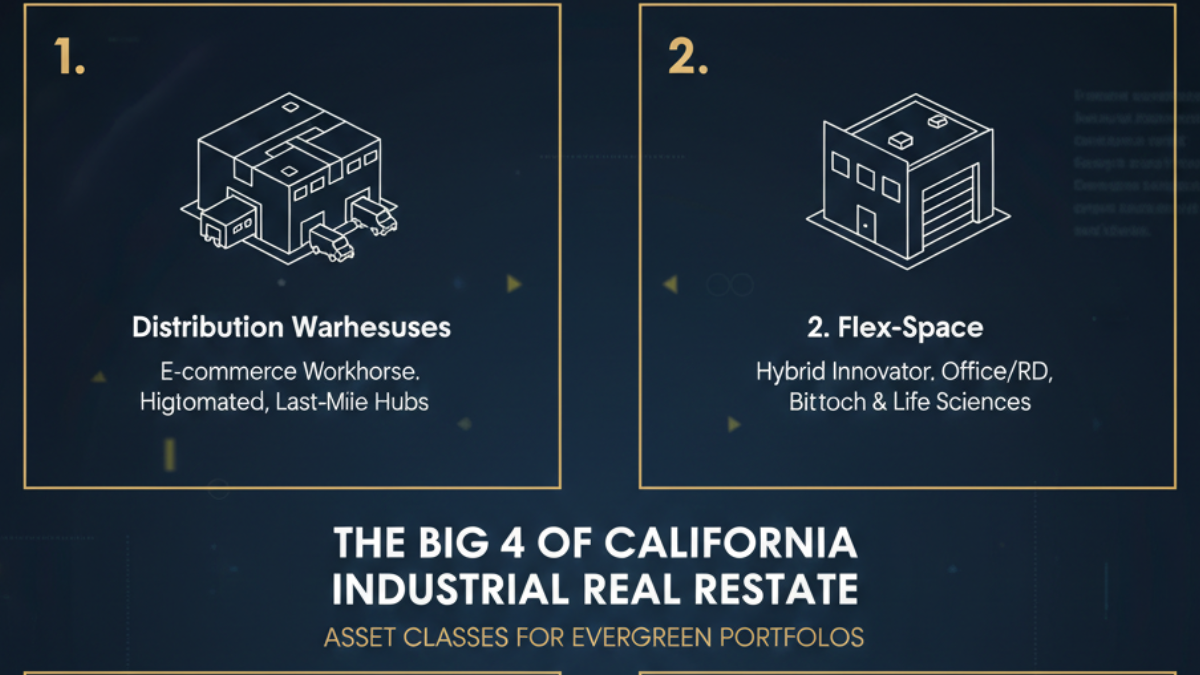
In the rapidly evolving 2026 landscape, industrial real estate investment has matured from a “niche” play into the backbone of the global economy. For California investors, understanding the specific “flavors” of industrial property is the difference between a high-yield portfolio and a stagnant one.
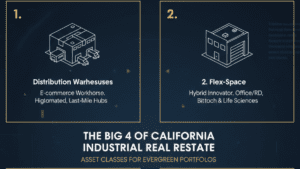
While every industrial building might look like a simple concrete structure, their internal DNA—infrastructure, power requirements, and lease potential , varies significantly. Here is a detailed breakdown of the “Big 4” asset classes driving the market today.
1. Distribution Warehouses: The E-commerce Workhorse
Warehouses and distribution centers are the most recognizable assets in the sector. In 2026, the focus has shifted toward last-mile delivery hubs , smaller, urban-infill locations that allow retailers to meet “same-hour” delivery expectations.
-
Key Features: High clear heights (now often exceeding 32–40 feet to accommodate vertical automation), abundant loading docks, and massive truck courts.
-
Investment Appeal: High liquidity and demand. With California’s vacancy rates for small-bay warehouses (<50,000 sq. ft.) hovering around 4.8%, these are “recession-resilient” assets.
-
The 2026 Edge: Look for buildings equipped for Autonomous Mobile Robots (AMRs) and rooftop solar installations to offset rising energy costs.
2. Flex-Space: The Hybrid Innovator
Flex-space is the “chameleon” of industrial real estate. These buildings typically feature a higher ratio of office space (30% or more) combined with a functional warehouse or “maker” area.
-
Key Features: Professional curb appeal, lower clear heights (14–24 feet), and versatile “roll-up” doors.
-
Investment Appeal: These properties attract tech startups, R&D labs, and creative agencies. Because they can be easily demised (split into smaller units), they offer lower vacancy risk by diversifying your tenant base.
-
The 2026 Edge: In markets like the San Francisco Bay Area, flex-space is being repurposed for biotech and life sciences, commanding significant rent premiums over traditional industrial use.
3. Manufacturing Facilities: The Production Powerhouse
With the continued trend of reshoring (bringing manufacturing back to U.S. soil), specialized production facilities are seeing a resurgence in California.
-
Key Features: Heavy power (3-phase electricity), reinforced flooring for heavy machinery, and specialized ventilation or drainage systems.
-
Investment Appeal: High tenant “stickiness.” Because a tenant often spends millions of dollars installing specialized equipment, they are much less likely to move, leading to long-term lease stability.
-
The 2026 Edge: Advanced manufacturing—think EV batteries and aerospace parts—requires massive power capacity. Properties with upgraded electrical grids are currently the “gold nuggets” of the California market.
4. Cold Storage: The High-Yield Niche
Cold storage real estate is the most specialized (and expensive) sub-sector. Driven by online grocery growth and pharmaceutical needs, these temperature-controlled environments are in critical undersupply.
-
Key Features: Advanced refrigeration infrastructure, “super-high-bay” racking (often 50+ feet), and insulated “sandwich” panels.
-
Investment Appeal: Cold storage is considered a defensive investment. People must eat and require medicine regardless of economic cycles. These properties can cost 2–3x more to build than dry warehouses, creating a massive barrier to entry that protects existing owners.
-
The 2026 Edge: Most California cold storage is over 40 years old. Investing in modern, multi-zone facilities (capable of handling frozen and chilled goods simultaneously) is the highest-growth strategy in the current market.
Connecting the Dots
Choosing the right property type is only half the battle. To truly understand why these assets are so valuable in the Golden State, you have to look at where they are located.
A high-spec warehouse is only as good as its proximity to the world’s most active trade routes. In my next post, we’ll explore the “Logistics King” and how the Ports of LA and Long Beach dictate the value of every square foot of industrial space in California.