For the seasoned real estate investor, the primary challenge eventually shifts from accumulation to preservation. While early-stage investing is about finding the right deal, late-stage investing is about managing the friction of taxes and legal liabilities. In 2026, as tax codes continue to evolve and wealth transfer becomes a priority for the “Great Wealth Transfer” generation, understanding advanced exit and entity structures is no longer optional—it is a mechanical necessity for staying ahead.
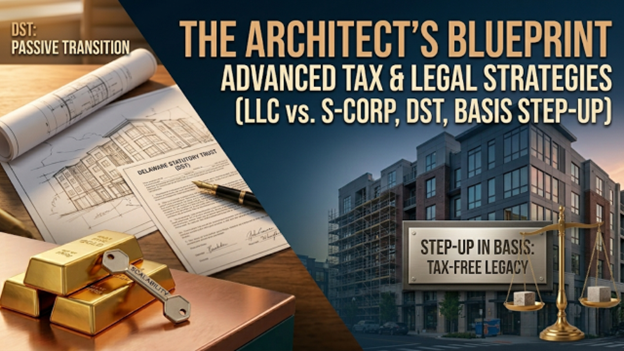
This guide explores the Delaware Statutory Trust (DST), the power of the “Step-Up in Basis,” and the structural debate between LLCs and S-Corps.
Advanced Exit: Beyond the 1031 Exchange
While the traditional 1031 exchange is a powerful tool for deferring capital gains, it often traps investors in a cycle of active management. You sell a property, only to have 180 days to find a “like-kind” replacement that you must then manage. For those looking to exit day-to-day operations without a massive tax bill, the Delaware Statutory Trust (DST) is the sophisticated alternative.
The Delaware Statutory Trust (DST) for Passive Reinvestment
A DST is a legal entity that allows multiple investors to hold fractional ownership in institutional-quality real estate—think Amazon distribution centers, medical office buildings, or 500-unit apartment complexes.
Why it’s a 2026 Power Move:
- Passive Transition: You can trade your active, “tenants-and-toilets” property for a fractional interest in a professionally managed asset.
- Diversification: Instead of putting all your 1031 proceeds into one building, you can split them across multiple DSTs in different markets and asset classes.
- Certainty: Because the properties in a DST are already identified and often already under contract or closed, you eliminate the “identification risk” that causes many traditional 1031 exchanges to fail.
Wealth Transfer: The Step-Up in Basis
The ultimate tax strategy in real estate isn’t just about deferring taxes; it’s about eliminating them for the next generation. This is achieved through the Step-Up in Basis.
How to Pass Generational Wealth Tax-Free
When you sell a property during your lifetime, you pay capital gains tax on the difference between the sale price and your original purchase price (your “basis”). However, if you hold that property until death and pass it to your heirs, the basis is “stepped up” to the current fair market value.
The Strategy in Action:
Imagine you bought a multifamily building in California decades ago for $500,000. Today, it’s worth $5 million. If you sell it, you owe taxes on $4.5 million in gains. If you pass it to your children, their new basis is $5 million. They could sell it the next day for $5 million and pay zero capital gains tax.
In 2026, using real estate as a vehicle for generational wealth is the most effective way to bypass the erosion of family capital. It turns “temporary” wealth into a permanent legacy.
Entity Structure: LLC vs. S-Corp
One of the most frequent questions from investors is how to hold their assets. The choice between a Limited Liability Company (LLC) and an S-Corporation (S-Corp) can have profound implications for both your legal protection and your IRS bill.
The LLC: The Gold Standard for Passive Assets
For holding rental properties, the LLC is almost universally preferred.
- Asset Protection: An LLC creates a “corporate veil” between your personal assets and your real estate. If someone slips and falls at your property, your personal savings and home are generally protected.
- Flexibility: LLCs offer “flow-through” taxation, meaning the income is reported on your personal tax return, avoiding the double taxation of traditional corporations.
- Ease of Transfer: Transferring interests in an LLC is often simpler than transferring deeds, making it a favorite for family estate planning.
The S-Corp: The Tool for Active Income
While S-Corps are popular for business owners to save on self-employment taxes, they are generally not recommended for holding appreciating real estate.
- The Trap: Taking a property out of an S-Corp can trigger a taxable event as if you had sold the property.
- The Use Case: An S-Corp is better suited for your management company or flipping business—where you are earning active income through services—rather than for long-term buy-and-hold assets.
| Feature | LLC (Rental Property) | S-Corp (Management/Flipping) |
| Tax Treatment | Flow-through to Personal | Flow-through + Payroll Savings |
| Best For | Passive Income / Long-term Hold | Active Income / Fee-based Work |
| Exit Strategy | Highly Flexible | Potentially Tax-Heavy |
| Self-Employment Tax | Not applicable to passive rent | Can reduce tax on “active” salary |
The 2026 Synthesis: Integrated Strategy
Advanced real estate investing is like a game of chess; you must think three moves ahead.
- Protect your assets today with a properly structured LLC.
- Defer your gains using a 1031 exchange into a DST when you are ready to stop managing properties.
- Preserve that wealth for your family by utilizing the step-up in basis.
By integrating these legal and tax strategies, you move beyond being a landlord and become a true Wealth Architect. You aren’t just collecting rent checks; you are building a fortified financial fortress that serves you during your life and your family for generations to come.